
How to Choose Wall Art Size: The Interior Proportions Guide
3 September 2026
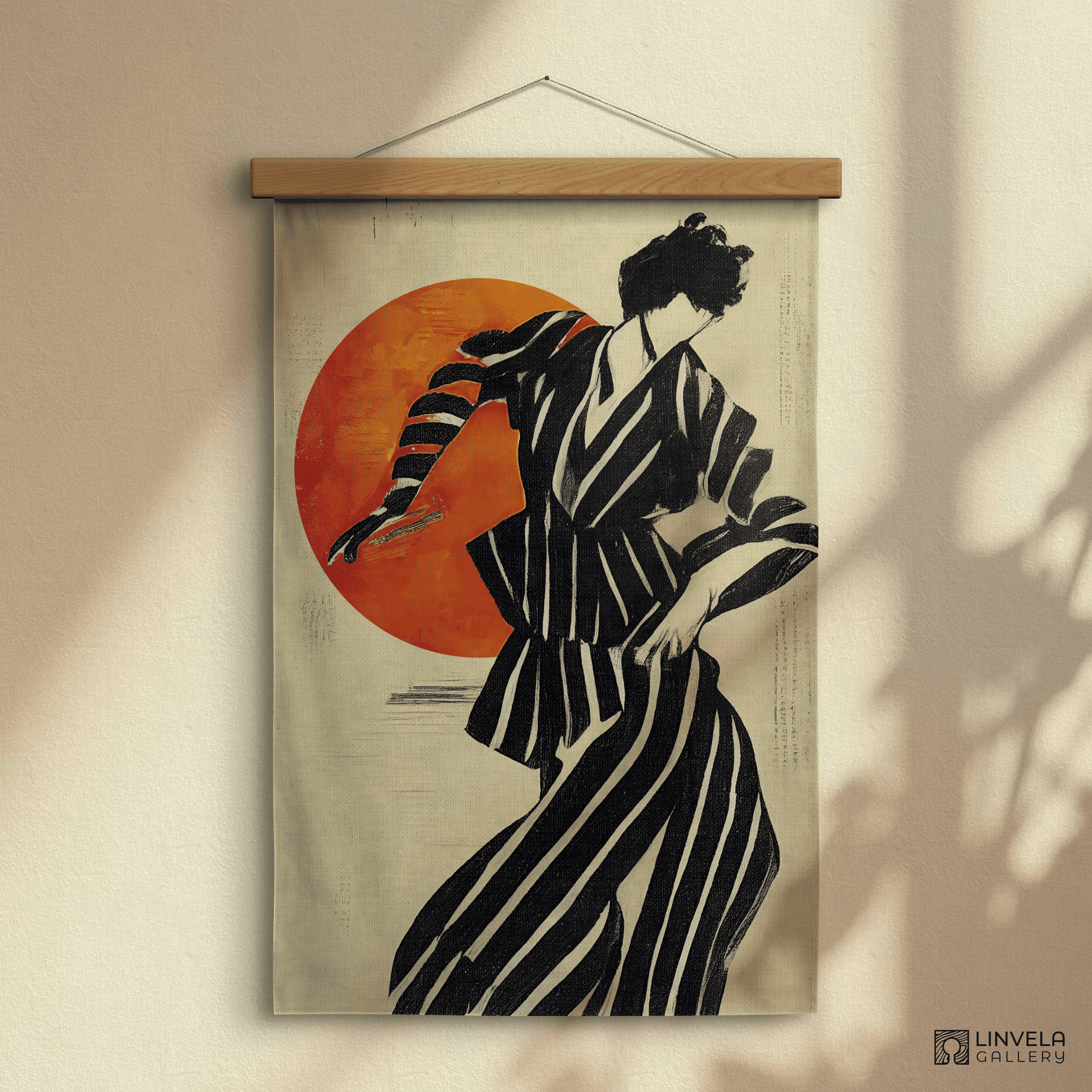
Selecting the right artwork dimensions is a matter of anchoring the piece to the existing lines of your furniture. To achieve a balanced visual weight, an artwork should span roughly 60% to 75% of the total width of the furniture resting directly below it. For example, a standard 200 cm living room sofa requires an art installation footprint of approximately 140 cm to balance the seating area properly. Choosing a layout based on these established structural lines ensures the final piece feels integrated into your space rather than floating ungrounded on an empty wall.
The Linvela sizing architecture is a dual-measurement system that intentionally matches fixed timber hardware widths (65 cm / 95 cm / 140 cm) with slightly narrower linen sheets (60 cm / 90 cm / 135 cm). This structural variance ensures a balanced, mathematically precise framing margin across all wall layouts.
Scaling Art to Your Furniture Lines
Choosing a large wall art living room piece usually comes with a bit of anxiety. If the proportions are off, the entire space feels unbalanced. The most dependable method to determine how to choose wall art size involves measuring the furniture piece that acts as the visual anchor for the wall area. Whether you are hanging wall art above sofa backrests, styling large wall art living room layouts, or sizing prints for dining consoles, the underlying rule remains uniform.
When artwork is too narrow relative to the furniture below it, the composition looks incomplete, making the wall appear vacant. Conversely, if the artwork extends past the margins of the furniture, the room becomes top-heavy. If you aim for the 60% to 75% coverage target, you establish an intentional margin of breathing room on either side of the display. For a 200 cm sofa, an artwork setup with a total horizontal footprint of 140 cm hits this ratio exactly, providing a clean boundary that aligns with standard interior architecture.
Centering the linen artwork within the carved timber channel leaves exactly 2.5 cm of exposed solid rail on each side. This design creates an integrated visual frame, utilizing the hardware width for physical wall clearance and the fabric width for pure artwork proportions.
Explaining the 5 cm Architectural Margin
If you want to understand the physical layout of our system, you must look at how the textile relates to the timber rail. The Linvela mounting system relies on a deliberate structural offset. The solid Slavonian oak or beech hardware is engineered to be exactly 5 cm wider than the corresponding linen print. This configuration yields a precise 2.5 cm margin of exposed wood on the left and right sides, creating a natural material frame for the textile.
When mapping out your wall art for living room spaces, always calculate your layout using the hardware width, as this represents the total horizontal footprint on your wall.
| Linvela Hardware Width | Matching Linen Art Width | Best Furniture Alignment |
|---|---|---|
| 140 cm | 135 cm | Large sofas (200–230 cm), king beds, grand consoles |
| 95 cm | 90 cm | Medium sofas (140–160 cm), queen beds, entry tables |
| 65 cm | 60 cm | Accent chairs, small desks, paired gallery layouts |
Anchoring large format wall art to your interior layout using the two-thirds proportion rule prevents a room from looking unbalanced. Choosing our maximum 135 cm width of 380 gsm natural flax linen grounds an expansive living room seating area beautifully without creating the harsh, distracting glare of traditional glass-fronted frames.
Fluid Height and Native Aspect Ratios
Most online wall art options force an image into arbitrary standard frame dimensions, which results in cropped details or stretched compositions. Our system preserves the integrity of the original design by using a dynamic vertical drop. While the horizontal hardware widths are fixed at 65 cm, 95 cm, or 140 cm, the height of the linen print adjusts naturally based on the native ratio of the selected artwork.
A Landscapes & Nature image captured in a 3:2 aspect ratio will have a shallower vertical drop than a Geometric & Minimalist layout or an Abstract graphic formatted in a 4:3 or 5:4 ratio. When reviewing sizes, verify the specific height listing of your chosen print to ensure it clears the top of your furniture comfortably. Ideally, leave a clearance of 20 cm to 25 cm between the bottom of the linen textile and the top of the sofa backrest or console table to maintain an uncluttered horizon line.
Selecting our maximum 135 cm format maximizes the visibility of the raw textile's organic profile. Under natural room lighting conditions, native flax characteristics like minor weave dots and subtle texture shifts become more noticeable across the expansive surface.
Overcoming the Mass of Traditional Framing
Deploying a traditional glass-fronted frame or a standard synthetic canvas wall art print for a large wall art living room installation introduces distinct material challenges. Unlike reflective glass frames or cheap canvas wraps that warp under environment shifts, our system relies on material integrity.
Opting for textile wall art changes how the art interacts with the room's environment. The 380 gsm natural flax linen—woven by heritage weavers in Poland and printed, digitally cut, and machine-hemmed under one roof in Varaždin, Croatia, features a matte, light-absorbing surface that eliminates glare entirely, ensuring clear visibility from any angle in the room. The material brings a soft tactile warmth to large walls without the bulky presence of traditional frames. Because the underlying flax is an organic material, it must be treated with care; refer to our care guide to understand why water cleaning must be avoided to preserve the structural stiffness of the fabric.
Rooms function best when their components can evolve alongside the people living in them. Fixed framing setups tie you to a single look due to the labor involved in dismantling them. By separating the solid timber mounting rail from the interchangeable linen print, the wall hardware remains a permanent fixture. This allows the visual identity of the room to shift across seasons without recurring installation labor or wall damage. Explore our catalog of curated artworks to find the right scale and style for your environment.
FAQ
How do I choose the correct wall art size for a living room sofa?
Measure the total width of the sofa and multiply it by 0.60 and 0.75. Your ideal artwork footprint should fall between those two numbers. For a standard 200 cm sofa, our 140 cm hardware width sits perfectly within this window, covering roughly 70% of the sofa's width.
Why is the Linvela timber rail wider than the linen print?
The hardware is built 5 cm wider than the linen artwork to leave an intentional 2.5 cm margin of exposed Slavonian oak or beech on each side. This exposure functions as an integrated border, accentuating the connection between the raw textile and the solid wood rail.
How does a linen print compare to traditional canvas wall art or paper posters?
Paper posters require protective glass frames that cause distracting room reflections and carry recurring framing fees. Synthetic canvas prints are often stretched over hidden, low-grade wood frames that warp over time. Our system uses a matte, light-absorbing 380 gsm natural flax linen that hangs flat without glare from a single-piece, warp-free timber rail.
Does changing the artwork require drilling new holes in the wall?
No. The initial installation of the Linvela timber rail requires standard physical mounting to your wall surface. Once that hardware is fixed in place, all future artwork updates are completely tool-free and non-invasive. You simply slide the internal support rod of the new linen print into the existing carved track.
How do dynamic aspect ratios affect the height of the hanging art?
We do not crop or distort art to fit rigid frame sizes. The width of your print is locked to your chosen hardware size, but the vertical height changes depending on whether the image is natively formatted in a 3:2, 4:3, or 5:4 aspect ratio. Exact heights are listed transparently across the catalog.